
Your wheel bearing might be bad if you hear unusual sounds like humming, squeaking, clicking, whirring, and more. Also, if your car wobbles or pulls to one side, you will want to get it checked. Bigger, wider tires can strain wheel bearings, causing accelerated wear and tear. If you hit a pothole, or road salt or sand gets past the seal and touches the wheel bearings, it could lead to premature failure and become a safety issue.
Imagine driving on the freeway when the left front tire and wheel suddenly break off, sending your out-of-control vehicle skidding across several lanes of 65 mph traffic. This is not an exaggeration. This is reality, and it can happen if you fail to notice the signs your car’s wheel bearings are deteriorating and need immediate repairs. Your wheel bearing might be bad if you hear unusual sounds like humming, squeaking, clicking, or whirring. Some experts say a bad wheel bearing can sound like a bird chirping. Also, if your car wobbles or pulls to one side, you need to get it checked.
If you aren’t sure if your wheel bearings are going bad, read on. We provide the signs and symptoms, the causes, how long you can drive on one, and the estimated replacement cost of a wheel bearing.
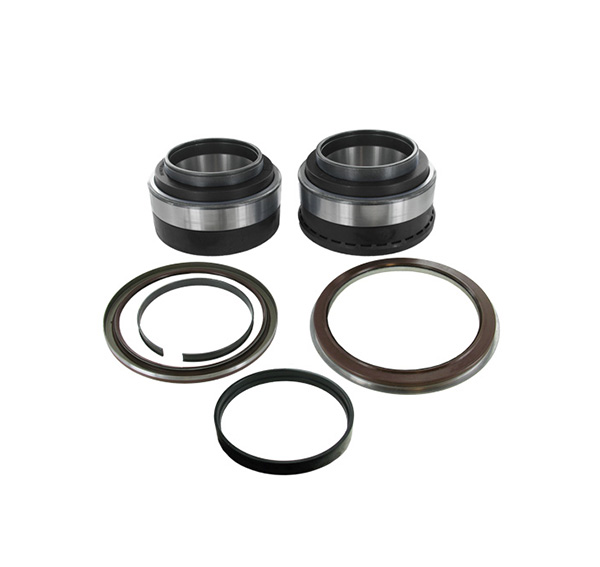
Wheel bearings connect a car’s wheels to the axles. They allow wheels to turn with minimal friction. Also, wheel bearings have a Herculean responsibility: They are engineered to support the vehicle’s entire weight.
Though wheel bearings are low-maintenance parts, they are important safety components of a vehicle’s braking, steering, and suspension systems. The one-piece hub assembly, between the drive axle and the brake disc or drums, incorporates the hub, wheel bearings, anti-lock braking system (ABS), wheel speed sensor, and mounting flange.
The bearings are tightly packed in a grease-filled, waterproof, sealed metal ring. This housing, called a race, is located inside the hub, and each wheel has one. Most vehicles today use sealed hub bearing assemblies that contain roller bearings. While we don’t address these, older cars used tapered roller bearings, which require servicing and preload adjusting to ensure the right amount of end play or axial clearance.
Your vehicle will signal that it’s time to replace a failed wheel bearing. For example, if you hear unusual sounds like humming or clicking, then your bearing might be bad. Watch out and listen for these signs, noises, and symptoms:
The most easily identifiable and common symptom of bad wheel bearings is audible. Problems may start as a faint hum or whirring noise that’s easily missed if your car cabin isn’t well insulated from outside noise. Additionally, the noise you hear could change in intensity with slight steering adjustments. But it can be confusing. For example, the source of a humming noise can be linked to other issues, such as tires and the CV joint.
The typical sounds of worn-out wheel bearings are squealing and/or growling that intensify as vehicle speed increases. Try to pinpoint the location of the noise, as this will identify the location of the worn-out bearings.
If you hear a clicking or popping sound at lower speeds or when turning the car, that may indicate a more advanced stage of wheel bearing failure, if not a damaged CV joint. If the sound increases in frequency as the vehicle accelerates, there could be a problem with the wheel hub assembly.
If one tire wears out faster than the others, it could be a sign that the wheel bearings are worn. It may look like scalloping on your tires. However, it also could be a sign the tire is improperly inflated (too much air pressure or not enough), the tires are improperly aligned, or the vehicle has damaged or worn suspension components.
When wheel bearings go bad, it brings the potential for wheel wobble due to uneven tire wear (see previous section). Technicians can check for wheel wobble by putting the vehicle on a lift and manually checking for wheel movement. Typically, it would be impossible to shake the wheel and tire. However, if it moves, the hub assembly needs immediate attention. The tire and wheel can literally come off the vehicle at any time, at any speed, if you don’t repair your vehicle. Additionally, when wheel bearings are in an advanced stage of failure, the brake rotors may lead to a pulsating feeling or unusual brake wear.
If a wheel bearing starts to fail, it can trigger the wheel’s speed sensor to send signals to your car’s warning light dashboard from the ABS or traction control sensor. It can happen even if your car isn’t losing traction or you’re not braking the vehicle. See a professional for repair.
Worn bearings may cause a vehicle to pull to the left or right when brakes are applied. The direction the vehicle pulls signals where the worn bearings are located, on the left or right side of the vehicle. However, this can also signal brake rotor or brake caliper problems.
Bad wheel bearings can cause the steering wheel to vibrate, and those vibrations might also be felt in the seats and floorboards. The intensity increases as the vehicle speed increases and the vehicle turns to the left or right. However, the vibration could be linked to an out-of-round tire (there could be a flat spot on the tire) or a tire that is no longer balanced. Another cause is damaged or worn suspension components.
If there is excessive play in the steering, meaning the steering seems less responsive or less precise than normal, worn bearings could be causing the problem. Also, this could be a sign the vehicle needs a wheel alignment.
If you have any of the signs listed above, visit a dealer service center or auto repair shop. Use Kelley Blue Book to find a repair shop to fix your wheel bearings.
When a wheel bearing starts to fail, you’ll begin to notice all the signs and symptoms, including initial wear and tear in your tires, and hearing noises you haven’t heard before in the car, such as a low humming or whirring sound.
If not addressed, as the wheel bearing failure progresses, you’ll hear the sounds and noises intensify, experience more vibration, brake issues, and wobbling wheels. That’s why detection is key.
Driving with bad wheel bearings impacts the safety of a vehicle, and it could cause a serious car accident. We do not advise driving on them when they fail and recommend getting them checked out as soon as possible. Bad wheel bearings can damage things like your hub, the vehicle’s constant velocity joint (CV joint), or the automatic transmission.
The good news is most of the time, a vehicle will let you know way before a failure ever happens,” said Gary Hardesty, Kelley Blue Book’s in-house service and maintenance expert and an A.S.E.-certified master technician. “The key is to listen to your car. Most times, a failing wheel bearing will exhibit a growling type of noise that changes with vehicle speed. The faster the car (goes), the faster the frequency of the growl.”
Wheel bearings are theoretically engineered to last at least 100,000 miles or more. But that’s not always the case, even if there is no maintenance schedule for replacing wheel bearings. Wheel bearings on electric vehicles (EVs) last even less than that. For example, Future Market Insights estimates that an EV’s wheel bearings may see a reduced lifespan by 15% to 20% due to heavier weight (curb weight) and torque spikes.
Ignoring worn-out wheel bearings can damage the vehicle’s constant velocity joint (CV joint) or automatic transmission. The outer CV joint attaches the driveshaft to the wheels, and the inner CV joint connects to the transmission. Here are things that can damage a wheel bearing:
Potholes, hitting curbs (curb bumping), and speed bumps taken at brisk speeds can damage wheel bearings, making them especially vulnerable.
Out-of-alignment wheels affect and damage wheel bearings. It’s important to keep your vehicle’s wheels properly aligned.
Damaged wheel bearing seals. If water, mud, road salt, or sand gets past the seal and touches the bearings, it will contaminate the grease, causing the bearings to wear down, eventually leading to failure prematurely.
Exceeding towing and payload capacities. Filling your vehicle with excess cargo and exceeding towing or payload capacity can put undue pressure on your vehicle. As a result, it can cause wheel bearings to fail.
Heads up: Planning to customize your vehicle with unique tires or rims? Be cautious with your choices. The original wheel bearings on your vehicle are designed to handle specific load capacities. While larger, wider tires or tires with lower sidewalls may enhance the look of your car, they also place additional strain on the wheel bearings, accelerating wear and tear. This added stress could lead to a potential safety risk if your bearings fail. To avoid these issues, it's best to adhere to the manufacturer's specifications when replacing or upgrading components.
Electric vehicles (EVs) are particularly sensitive to wheel bearing wear due to their instant torque delivery. Quick, high-torque spikes can contribute to faster degradation of the bearings, making it crucial to monitor their condition closely if you're driving an EV.
Catch Problems Early: If you notice any unusual noises or suspect an issue, it’s a good idea to have your vehicle inspected by a reputable service technician. They can diagnose issues based on warning lights or perform a spin wheel test to catch any abnormalities.
Regular Vehicle Maintenance: Keeping up with regular service intervals as outlined in your vehicle’s manual is essential. Not only does this help identify potential bearing issues before they become serious, but it also helps maintain your vehicle’s value. Be sure to ask your technician to check your bearings during every tire rotation.
Preventive Measures: Avoid curb strikes, excessive payloads, and keep your vehicle within its weight limits. After off-roading or activities like boat launches, make sure to rinse off road salt, mud, and sand from the hub area where the wheel meets the axle to prevent premature wear.
Be Mindful of Wheel and Tire Upgrades: Before making any upgrades, review your owner’s manual to ensure that your new tires and rims do not exceed the manufacturer’s specifications. Exceeding load ratings can place extra strain on your wheel bearings.
Check for Safety Recalls: Some vehicles may have recalls related to wheel bearings. For instance, there’s an ongoing safety recall for the 2025 Ram 1500 due to possible damage to the front wheel bearing encoder rings, which could impair the vehicle's electronic stability control system. Be sure to check for any relevant recalls on your vehicle to address potential issues before they become critical.
Smart Upgrades: If you frequently drive an EV or tow heavy loads, consider upgrading to ceramic hybrid or insulated wheel bearings. These options offer enhanced durability and heat resistance, which is especially beneficial for vehicles that experience heavy strain.
On average, the cost to replace a wheel bearing is around $350 per wheel, before taxes. However, the price can vary significantly depending on factors like the vehicle's make and model, the labor rate of the garage, and the cost of parts. For luxury cars and electric vehicles, the price may exceed $700 or more.
The cost of replacing a front-wheel hub assembly can also differ widely. The make and model of the vehicle, labor rates, and part costs all influence the total price.
If the bearing fails on one wheel, it’s generally not necessary to replace the bearings on the other wheel of the same axle—don’t let anyone talk you into unnecessary work.
Also, keep in mind that upcoming car tariffs on imported parts may cause the replacement costs to rise in the near future. Be sure to get an estimate for your specific vehicle’s wheel bearing replacement.
Let me know if you'd like further adjustments or additions!

66 Panzhuang Bearing Industrial Park, Linqing City, Shandong Province, China.
+86 635 277 7999
Keywords:
Spherical Roller Bearings, Tapered Roller Bearing, Cylindrical Roller Bearings, Truck Hub BearingCopyright © Linqing Longfei Bearing Co., Ltd. All Rights Reserved. |
Sitemap
| Powered by
